
Everyone’s waiting for the video that changes everything
Most creators treat YouTube growth like a lottery ticket. Post consistently, hope one video hits, and ride the momentum. The problem is that for the vast majority of channels, that moment never arrives, and even when it does, the algorithm doesn’t automatically carry the wave forward.
What actually works, based on how channels grow over time, is less dramatic. Small improvements to existing content compound. A title rewrite lifts click-through rate. A thumbnail change on a video from eight months ago starts pulling new impressions. Channels that grow past the 10K-50K plateau tend to be the ones iterating on what they already have, not the ones waiting for a breakthrough upload.

This piece is about those small moves. Not shortcuts, and definitely not promises of viral results. Just the specific, low-effort changes that successful channels make repeatedly, what signals they watch, and how they decide what to fix first. If you’re expecting a system that takes one afternoon and triples your views, this isn’t that.
The difference between a quick win and wishful thinking
A quick win refresh is a change you make to something that already exists, takes under a few hours, and produces a signal you can measure within two to three weeks. That’s the whole definition. Thumbnail swap, title rewrite, updated description, trimmed intro, adjusted end screen. The work is small; the feedback loop is short.
What it is NOT is a content overhaul. Reshooting a video, rebuilding your channel niche, changing your upload cadence, or redesigning your brand identity are strategy moves. Those decisions take months to read properly and carry real opportunity costs. Calling them quick wins is how creators end up exhausted with no useful data.
The signals that matter for a refresh are specific: click-through rate (CTR) tells you whether people are choosing your video over others when YouTube shows it to them; average view duration (AVD) tells you whether they stay once they click; and subscriber conversion rate tells you whether one-time viewers become repeat ones. A refresh targets exactly one of those. If your CTR is low but your AVD is strong, you have a packaging problem, not a content problem. Those require completely different changes.
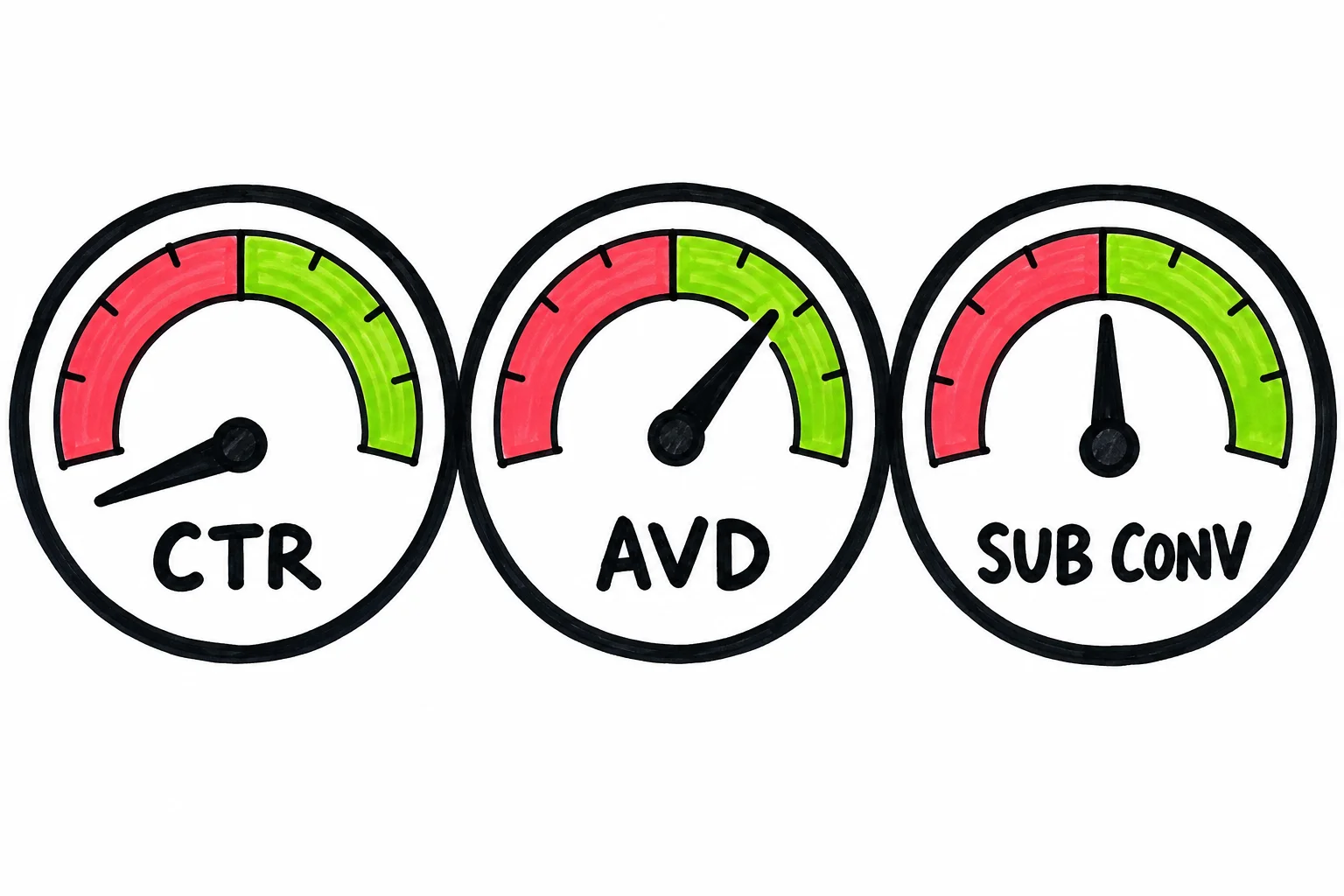
The other thing quick wins are NOT: random experimentation. Changing a thumbnail because you’re bored, or because a newer video did better, is not a refresh strategy. You need a reason based in data before you touch anything. That discipline is what separates channels that learn from their library from channels that just keep posting and hoping.
When changing one image is worth more than making a new video
Here’s a scenario that plays out constantly on mid-size channels. A tutorial video accumulates 40,000 impressions over three months and sits at a 3.1% CTR. The creator assumes the video just isn’t very good. They move on and upload something new.
What they missed: 3.1% on 40k impressions is a packaging problem, not a content problem. YouTube showed the video to 40,000 people and only about 1,240 of them clicked. The content never got a fair trial.
A documented case on ThumbPreviewer tracks exactly this situation. A creator with an evergreen video stuck at 3.1% CTR swapped the thumbnail while keeping the title identical. CTR moved to 4.4%, a 42% relative lift. Within 30 days, the algorithm had doubled impressions on the video, and watch time roughly doubled alongside it.
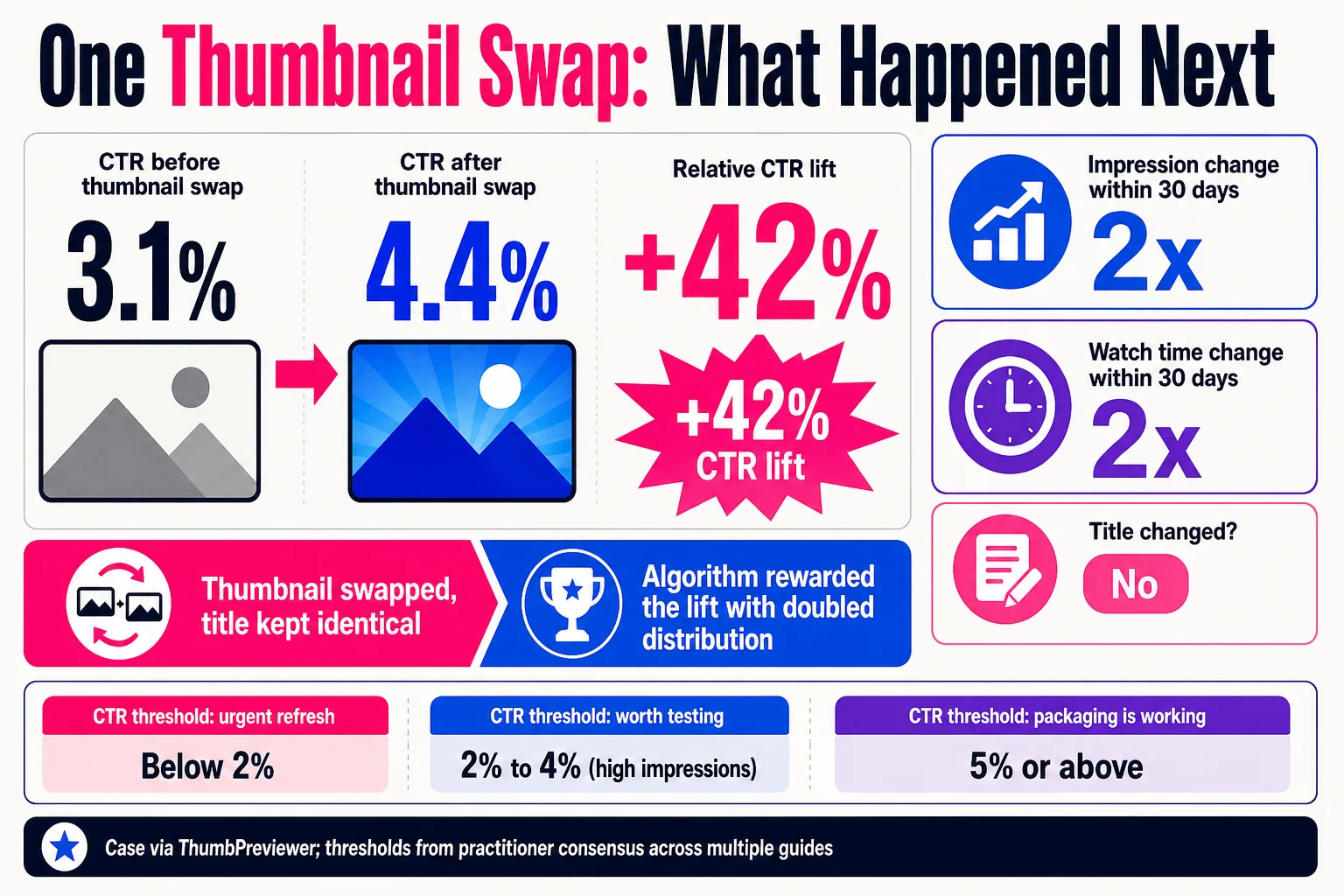
The decision logic matters more than the specific numbers. These creators watch for two conditions before touching anything: impressions above 10,000 (enough data to trust the CTR reading) and CTR below 4%. Below 2% is urgent. Between 2% and 4% on high-impression videos is worth testing. Above 5%, the packaging is working and the problem, if there is one, lives inside the video.
When both conditions are met, most practitioners test thumbnail first, because thumbnails drive roughly 70% of the initial click decision on mobile. The title gets changed if a thumbnail refresh alone doesn’t move the number after about seven days, or if the title is clearly not matching what the thumbnail promises visually.
The tradeoff worth naming: touching a video that already ranks carries real risk. If it’s getting steady search traffic at position four, a metadata change can temporarily disrupt indexing while YouTube re-evaluates the content. The safer move is to test thumbnail only, leave the title alone unless the CTR stays flat, and give it a full two weeks before drawing any conclusions.
Your retention curve is a crime scene, not a report card
CTR gets most of the attention, but average view duration is where you find a different kind of problem. Low CTR means people aren’t clicking. Low AVD after a reasonable CTR means people clicked, looked around for twenty seconds, and left. The intro is almost always why.
The diagnostic step matters more than the fix. Pull up the retention curve in YouTube Studio and look at the shape of the first thirty seconds. A healthy open holds relatively flat or drops gradually. A broken hook drops sharply in the first ten to fifteen seconds, often 30-40% of viewers gone before the video has done anything. That steep early cliff is the signal.
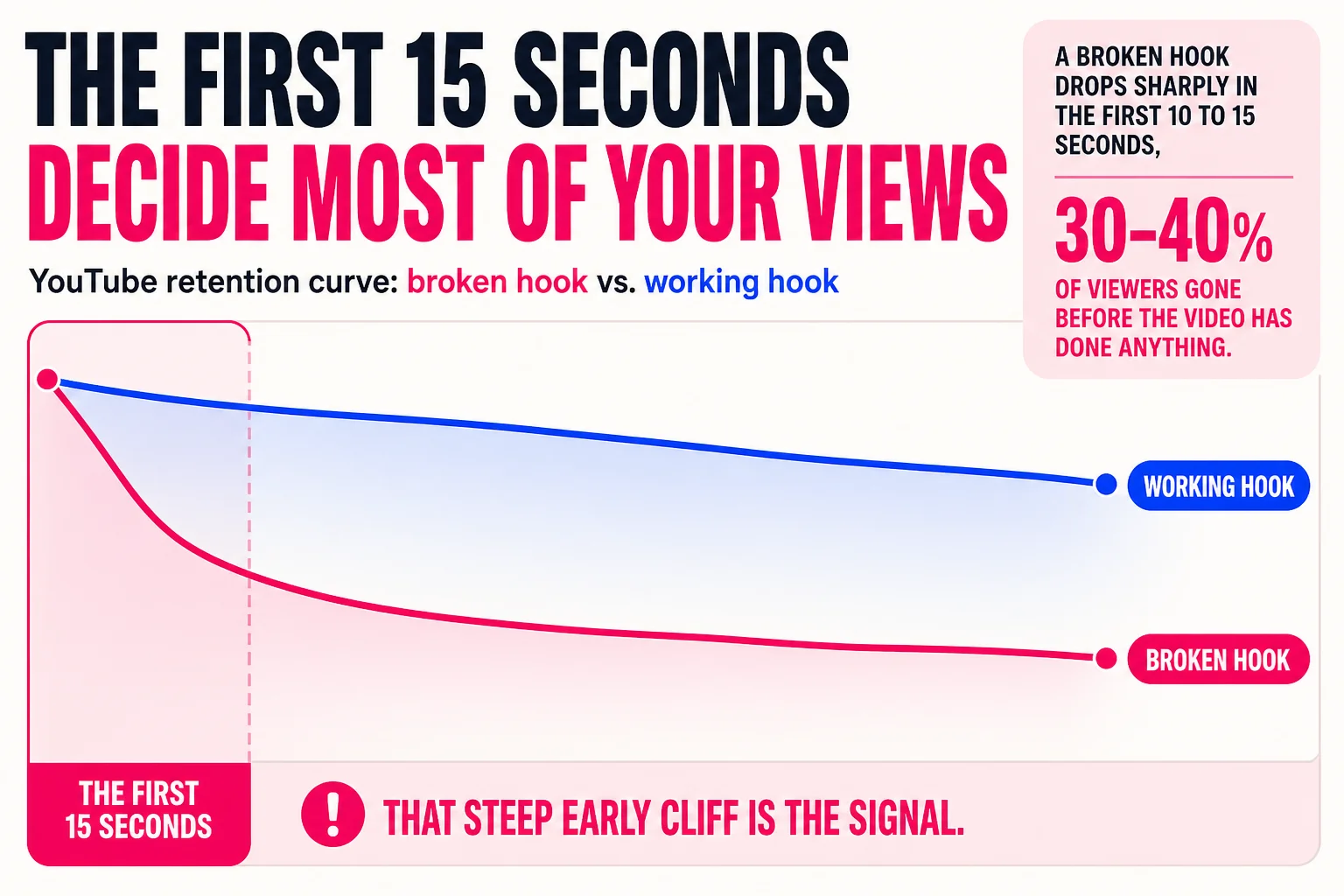
One finance channel documented this publicly: a video sitting at 35% average view duration had good CTR and solid content past the two-minute mark. The problem was a forty-second intro that opened with the creator’s logo animation, a verbal recap of the channel, and a slow wind-up before stating the point. They recut the intro in editing software, starting the video at the moment the actual argument began, and re-uploaded it. AVD moved to 52% within three weeks.
The only caveat worth stating plainly: this only works if the content past the intro is genuinely good. Re-hooking a weak video just gets people to the bad part faster.
Not every video deserves your attention — here’s how to sort them
Hard filter first: fewer than 1,000 impressions in the last 90 days, skip it. YouTube hasn’t shown it enough to give you reliable CTR data, so any change is guesswork.
For everything above that threshold, work this order.
First priority: high impressions, low CTR (under 4-5%). Packaging problem, cheapest fix. A thumbnail swap takes two to five minutes; a title rewrite takes less than three. Creator case studies report CTR jumping from the 2-4% range to 8% or higher after a single thumbnail change. High impressions mean more eyes see the new version immediately, which is why this tier has the most upside — and the most downside if you swap to something worse.
Second priority: decent CTR but AVD under 35-40% of video length. Hook or pacing problem. Medium effort, medium timeline (see the previous section).
Third priority: strong historical CTR and AVD, but impressions have dropped more than 50% over the past six to twelve months. This is SEO decay: the video still works, but search isn’t surfacing it. Update the title, description, and tags to match current search language. Low effort, moderate expected recovery.
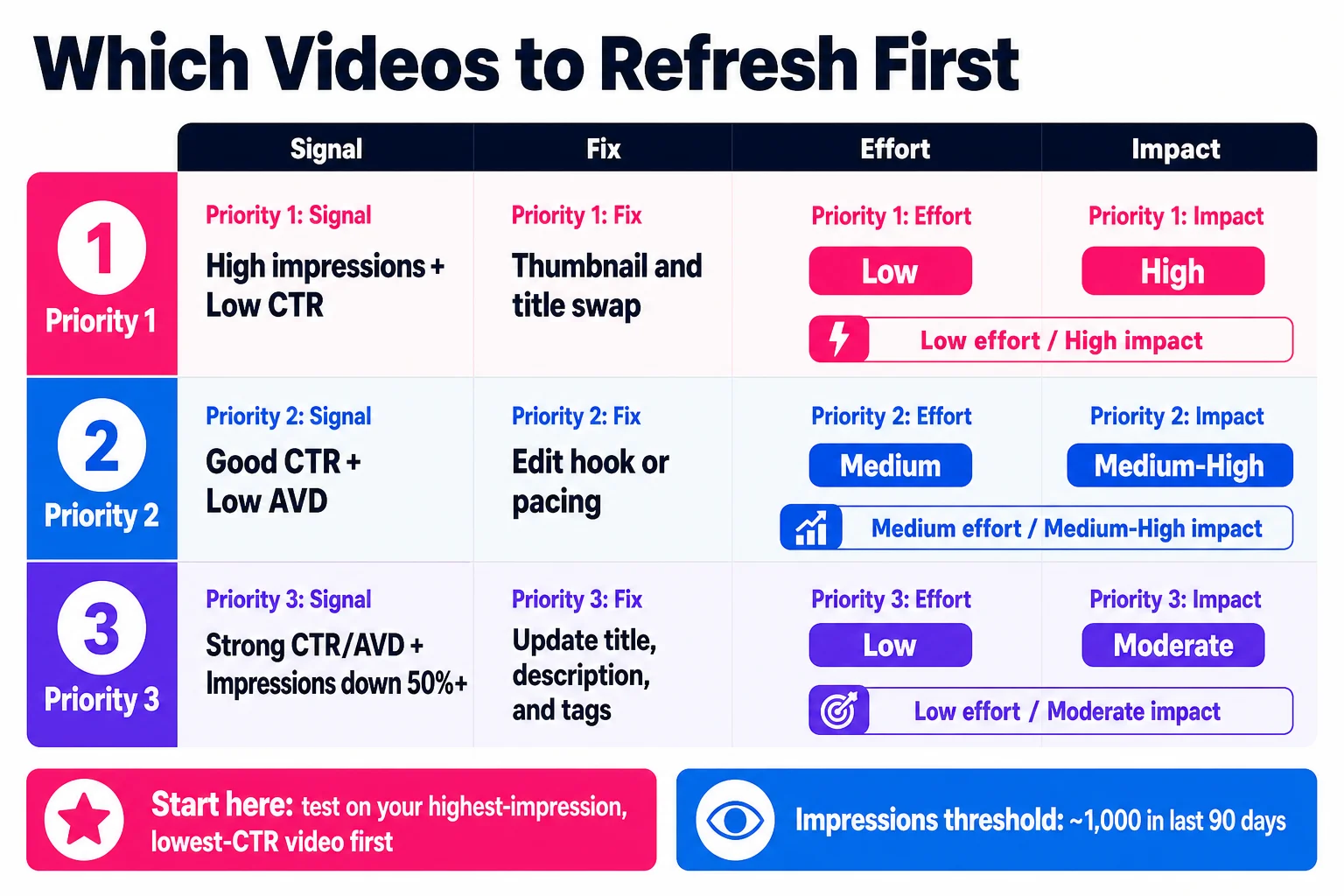
One tradeoff worth naming: the higher the impressions, the more a bad refresh hurts. Start with your highest-impression, lowest-CTR video and treat it as a test before touching anything else.
Four ways creators waste a perfectly good refresh
The most common one: refreshing a video that was never underperforming. If impressions are steady and CTR is healthy, there is nothing broken to fix. Changing the thumbnail on a stable video introduces noise without any upside, and if the new version underperforms, you’ve just replaced something that worked.
Second: changing thumbnail, title, description, and tags at once. Changing multiple variables in a single pass means you cannot tell which change moved the needle. You end up with a result and no actionable information about why.
Third: refreshing the same video repeatedly in a short window. YouTube’s recommendations run on accumulated engagement signals, not on your most recent edit. Frequent edits in quick succession fragment whatever signal the video had built. Wait at least seven to fourteen days between attempts.
Fourth, and probably the costliest: treating a content problem as a packaging problem. A thumbnail can get someone to click. It cannot make them stay. If retention is the issue, no title rewrite fixes that.
Start with one video, not a system
Open YouTube Studio, pull the last 90 days of impressions, and flag your top videos by impression count that sit below roughly 5% CTR. Those are your candidates. Pick one. Swap the thumbnail. Change nothing else.
Then wait. High-impression videos can show early signals within a few days, but two to three weeks gives you a reliable read. A lift of 0.5 percentage points or more above your channel’s recent average is worth keeping.
Once you’ve run that first test, build a rolling habit: one refresh per week from your flagged list, a fresh audit every quarter. That’s the whole system.
The next action is today: open Studio, sort by impressions, find the gap.
References
- YouTube Help: Impressions and click-through rate — YouTube Help
- YouTube Help: About the Audience tab and viewer metrics — YouTube Help
- Databox: How to improve YouTube CTR — Databox
- Thumbnail Test: How often to change a YouTube thumbnail — Thumbnail Test
- TubeBuddy: Common YouTube mistakes and how to avoid them — TubeBuddy