
You woke up to a 30% traffic drop. Now what?
It’s Monday morning. You open Search Console and the graph looks like someone knocked a coffee mug off a desk. Thirty percent of your organic traffic, gone overnight. Your first instinct is to open five browser tabs — volatility trackers, ranking tools, SEO forums — and start looking for the explanation that makes this feel controllable.
That instinct is the problem.
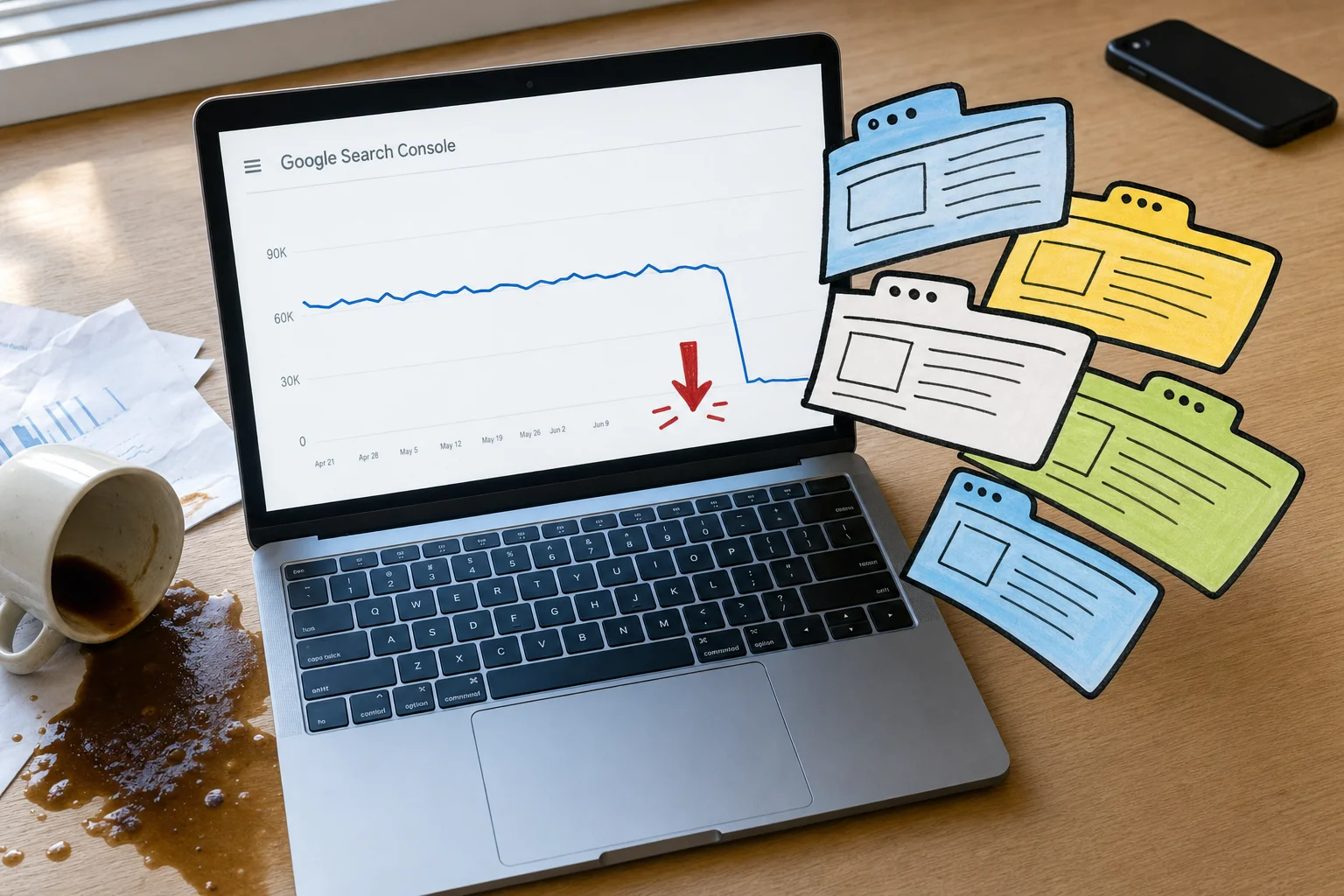
Google ran four named core updates in 2024 alone, with rollouts lasting anywhere from 13 to 45 days. The data is everywhere. What’s rare is knowing what to do with it before panic sets in.
The hard truth from recovery case studies is that most traffic drops expose issues that existed before the update. The update didn’t break anything. It just stopped tolerating what was already broken. No dashboard tells you that. Only a structured response plan does.
That’s what this post is actually about.
Noise vs. signal: the part that actually matters
Think of it like weather versus climate. A cold Tuesday in July is not evidence that summer is over. Your rankings moving two or three positions in either direction on a given day is the Tuesday. It’s normal atmospheric behavior. MozCast’s baseline sits around 70°F for typical daily SERP activity. Readings that climb past 100°F suggest something broader is happening. The tool is literally a thermometer, and most people are calling the ambulance every time they feel a draft.
The three things people conflate are ranking fluctuations (constant, mostly meaningless), algorithm volatility (broad, industry-wide, sustained), and site-specific technical problems (isolated, tied to your crawl or index). They feel identical in Search Console at first glance, which is why the first response should be diagnostic, not corrective.
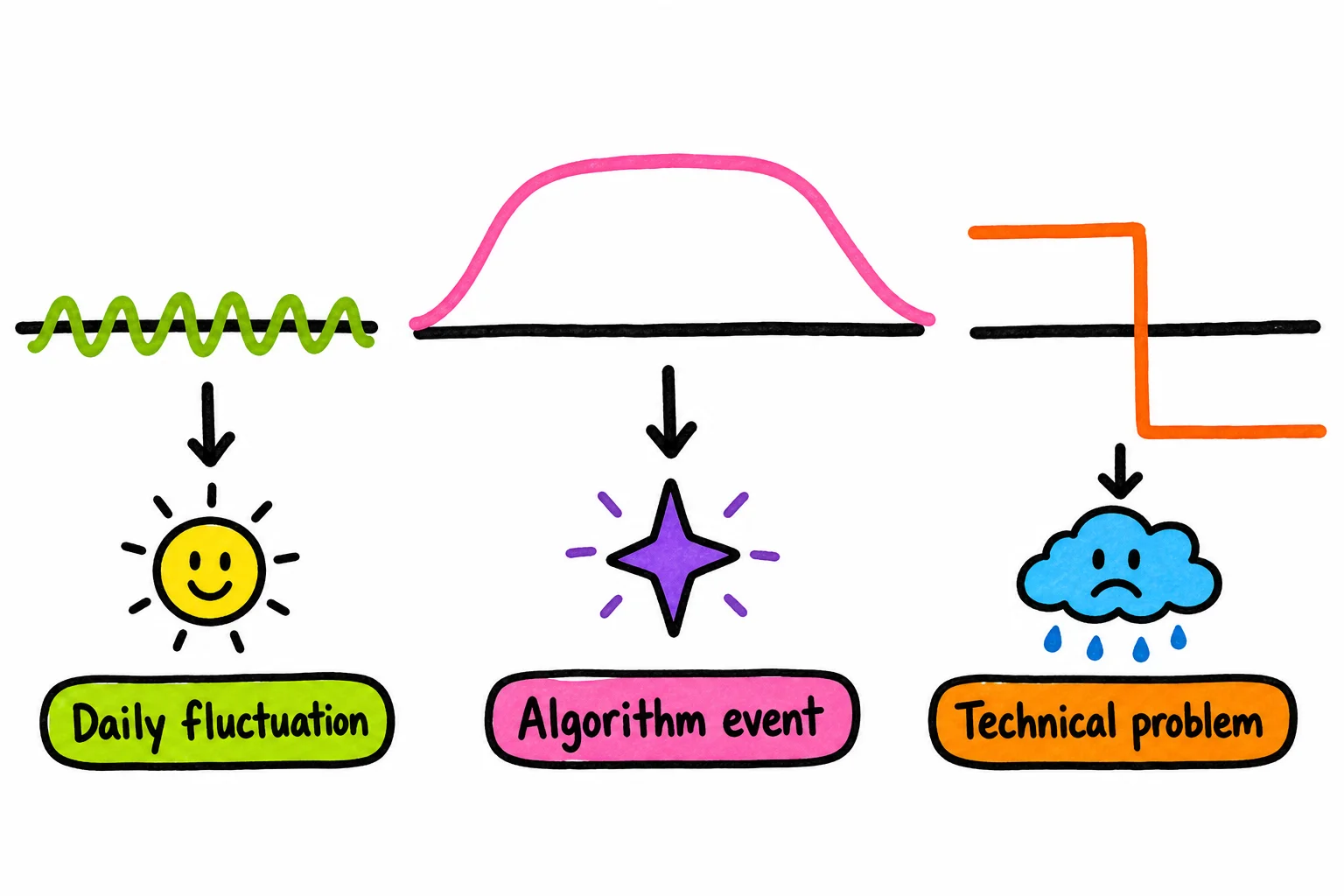
Here’s a practical filter. A position shift under three spots, no GSC crawl or indexing errors, and no corresponding movement in your competitor rankings? Log it, watch it for a few days, leave it alone. Small shifts often rebound within two to three days when there’s no underlying technical cause.
A response is worth considering when the drop is site-wide across many pages, competitors in your space show similar movement, and the timing lines up with a confirmed update window. That combination points at an algorithm event. If the drop is sudden and isolated to specific pages or sections, and GSC shows crawl errors or a noindex problem, that’s a site problem wearing algorithm clothing. Fix the site; don’t audit your content strategy.
Three tools that actually help you decide something
Once you’ve confirmed the drop looks market-wide rather than isolated to your site, you need instruments. Three are worth your time, and they work best in sequence.
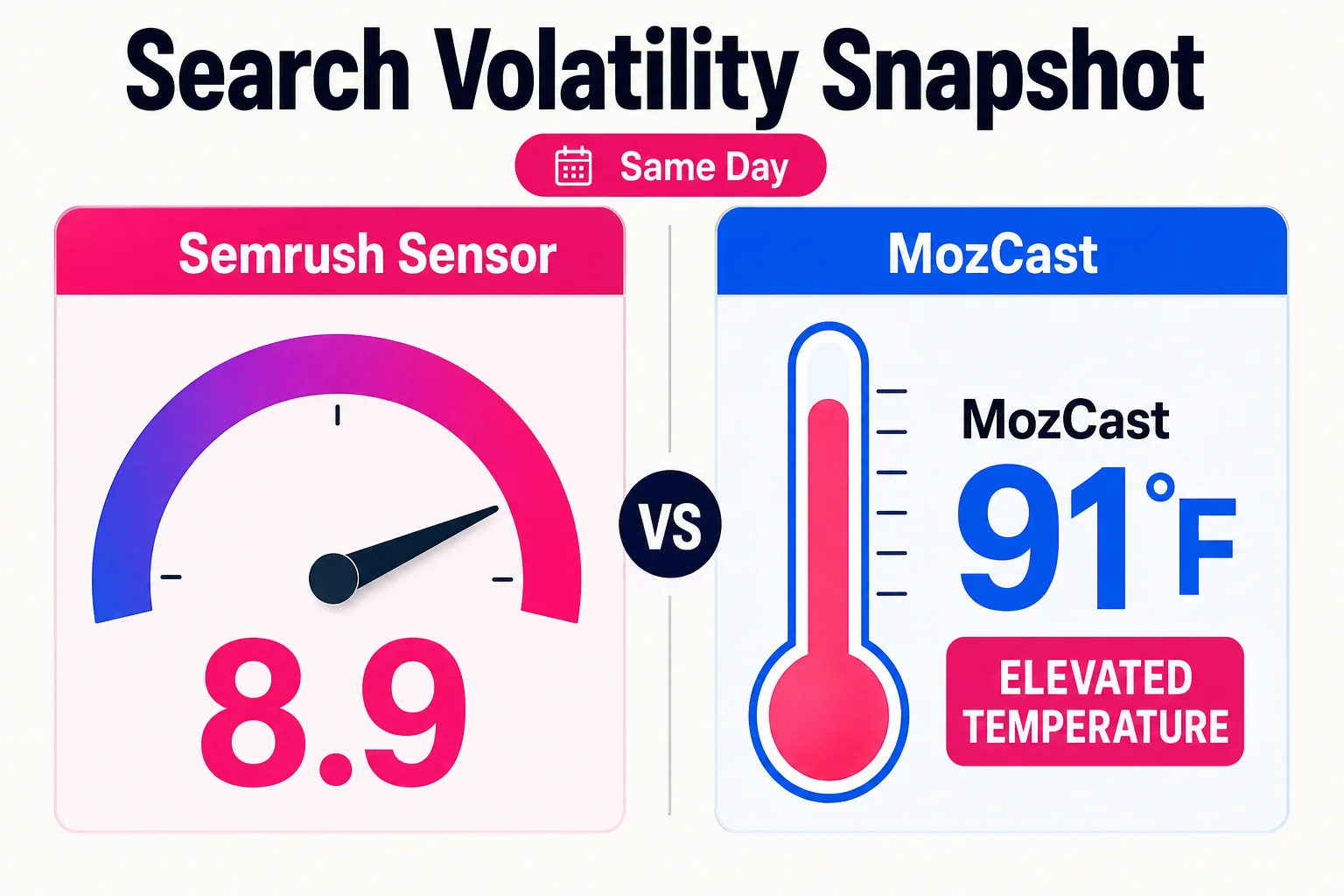
Semrush Sensor measures daily SERP volatility on a 0 to 10 scale across industries and countries. When it hits 8 or above, treat that as a signal to pause any major site changes you had planned. Not because Sensor is authoritative, but because making structural edits during a confirmed turbulence window makes your results impossible to read later. During early March 2026 it reported scores near 9.5, which was a reasonable prompt to stop, watch, and wait. The tradeoff: the keyword sample is fixed and proprietary, so it may not reflect your specific niche at all.
MozCast gives you a temperature reading based on roughly 1,000 US desktop keywords. Its value is historical context. You can see whether today is genuinely unusual or just a warm Tuesday. Its limitation is the same as Sensor’s: it’s US-only, desktop-weighted, and underrepresents newer SERP features like AI Overviews.
Google Search Console is the third tool, and the most authoritative, but it runs 2 to 3 days behind under normal conditions. There is a fresher 24-hour view with hourly granularity added in late 2024, but GSC is still better for confirming a trend than catching one. Use it to validate what the volatility indices flagged, not to spot the fire first.
Decide now, before the traffic drops
The tools tell you that something is happening. A response plan tells you what to do about it. Those are different problems, and the second one is harder to solve under pressure.
Three forks to decide in advance.
Is this a confirmed update or noise? Check the Google Search Status dashboard first. If Google has announced an update is in progress, you are in a confirmed volatility window. If there is no announcement and your volatility tools are reading below 7, you are probably dealing with normal fluctuation. The right response to normal fluctuation is to do nothing and check again in 48 hours.
Is my site in the affected pattern? A broad core update hitting health sites does not mean your e-commerce store is in trouble. Pull your Search Console data and look at which pages lost impressions. If losses are concentrated in a topic cluster that matches what analysts are reporting, you have a site-level signal. If losses are scattered across unrelated pages, the cause is probably not what the headline update is targeting.
What is my response threshold? Decide before anything happens: a 10 to 15 percent traffic drop over one week triggers monitoring only. A 30 percent drop sustained over two weeks triggers an offline content audit. A 50 percent drop triggers a full review including link profile, technical crawl, and E-E-A-T assessment. Write those thresholds down. A 25 percent drop feels catastrophic when you are watching it happen, and people without a pre-committed threshold almost always over-react.
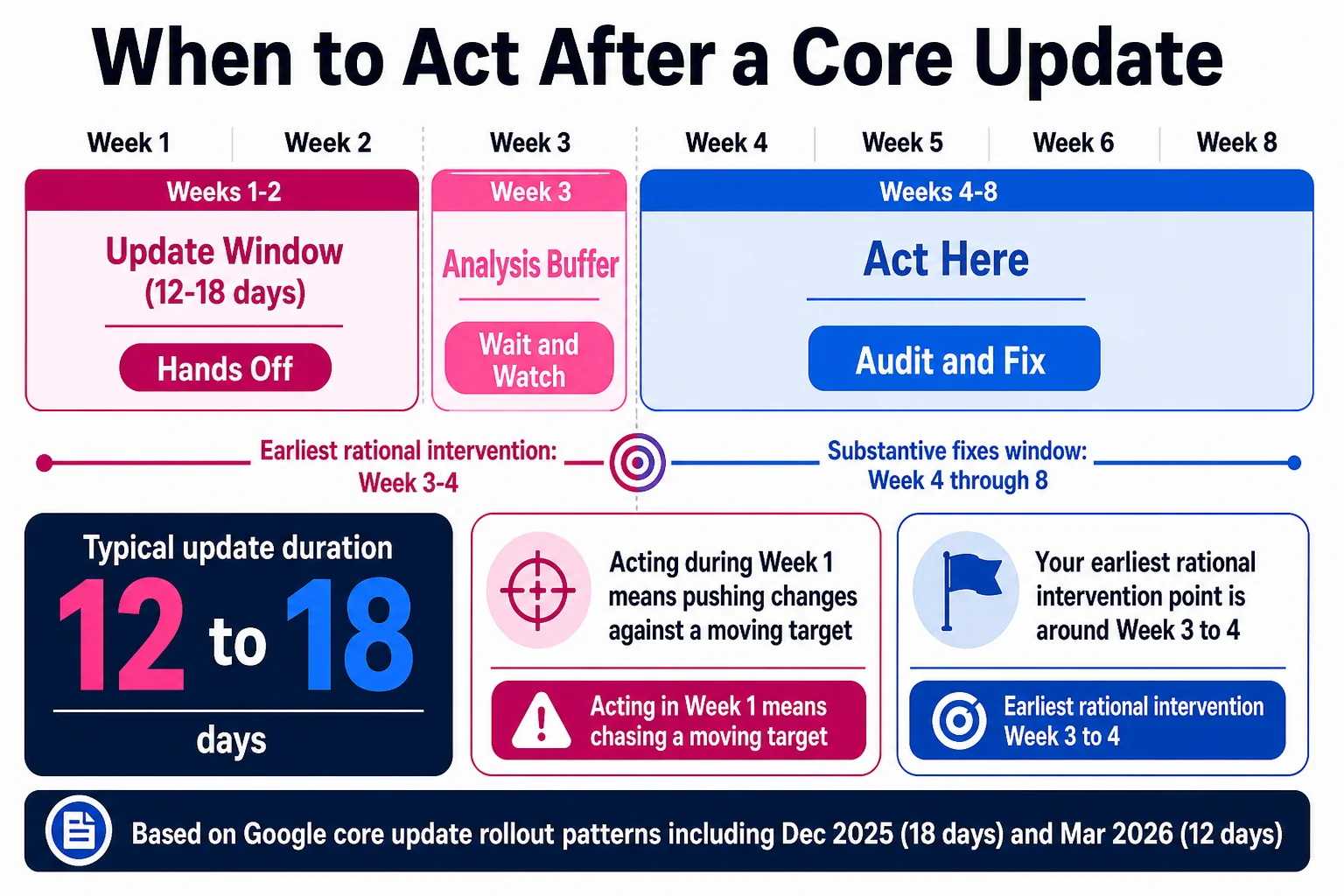
The most expensive mistake in this process is making site changes during a rolling update. Recent core updates run 12 to 18 days from start to finish, with signals shifting throughout. Changes pushed during Week 1 get evaluated against a moving target. Freeze edits until the update is confirmed complete, then wait at least one additional week before drawing conclusions. Your earliest rational intervention point is around Week 3 to 4, with substantive fixes starting in Week 4 through 8.
Waiting feels wrong. That is exactly why you need the plan written before the drop happens.
The moves that look productive and aren’t
The freeze-edits rule breaks down in one predictable way: people read the tracker, see a spike, and start deleting pages. That decision makes it impossible to separate Google’s signal from your own edits, because you’ve changed the site mid-rollout.
Deleting or consolidating underperforming pages during an active rollout is the most common mistake. Updates run 2 to 4 weeks, with rankings oscillating throughout. Pages you pull in Week 1 may have recovered by Week 3. You’ll never know, and Google now has to evaluate a different site from scratch.
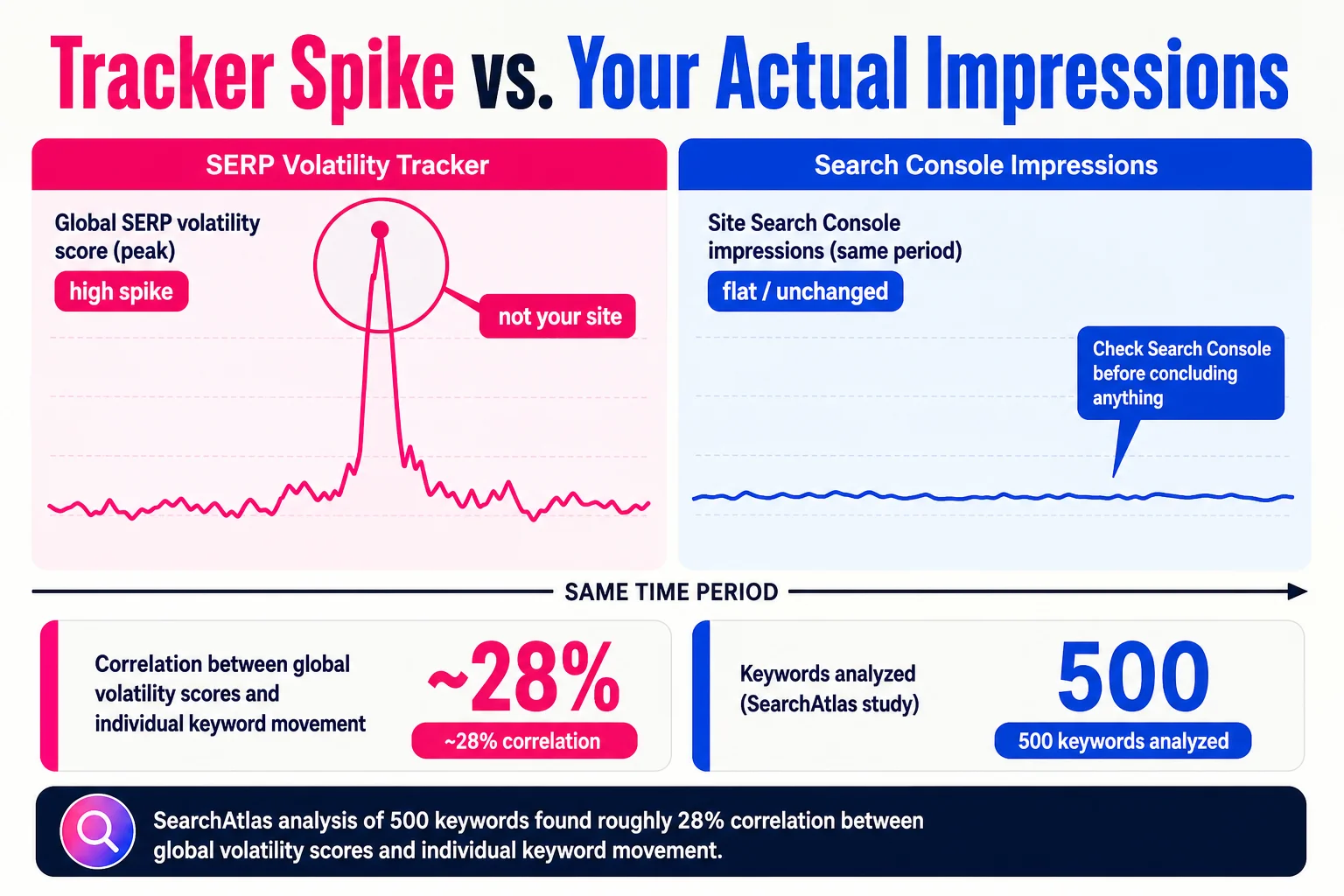
The second mistake is treating a tracker spike as confirmation your site was hit. SearchAtlas analysis of 500 keywords found only about 28% correlation between global volatility scores and individual keyword movement. A spike often reflects competitor reshuffling. Cross-check Search Console impressions and Analytics traffic before concluding anything.
Third: writing off stable pages as casualties. If impressions held but rankings shifted slightly, that’s noise. Treating it as damage triggers rewrites that introduce new variables right when you need a clean baseline.
Fourth is rushing fixes after a real hit. Sites that make wholesale changes immediately after an update tend toward 6 to 12 month recovery timelines. Sites that wait for stabilization and act methodically tend to recover in 3 to 6 months.
Triage first, then fix
Once Search Console data has settled, work in this order.
Confirm the event. Open the Performance report, compare the 28 days before and after the update’s start date, and filter by page. A site-wide drop points to an algorithmic cause. A drop concentrated in one section points to a segment problem.
Identify what fell. Export the top-drop pages, sort by click loss, and score each roughly against Google’s E-E-A-T criteria: named author, original analysis, cited sources, evidence of real experience. Pages scoring below 5 out of 10 are your queue.
Read the pattern before writing anything. Are losses concentrated in thin pages under 800 words? Duplicate-intent URLs? Outdated data with no visible refresh date? The pattern tells you whether to consolidate, rewrite, or redirect.
Decide scope. If fewer than 20 pages account for 80% of the loss, fix those pages: add author credentials, update time-sensitive figures, submit via URL Inspection to accelerate reindexing. If damage is spread across hundreds of pages, consolidating into fewer, stronger hubs is the more realistic path.
Recovery signals typically show up in the next update cycle, not the current one.
Waiting is a plan, not a failure
The instinct to act fast during a traffic drop feels responsible. It isn’t, most of the time. Google explicitly recommends waiting until a rollout fully completes, then waiting another week before drawing conclusions. The March 2026 update ran 12 days. Anything you changed on day three was based on incomplete data.
The best response plan is a waiting plan with defined escalation triggers: if traffic is still down 30% or more two weeks after rollout completion, then analyze and act. If it isn’t, keep improving content quality and let the next update do its job. Recoveries follow deliberate quality improvements, not urgency.
When the data settles and a pattern is clear, act on pages where E-E-A-T gaps are concrete and fixable.
References
- Google Search Status Dashboard — Google
- Google Search Central: Core updates — Google Search Central
- Search Engine Land: Google core updates guide — Search Engine Land
- Search Engine Journal: Google algorithm update history — Search Engine Journal
- Semrush Sensor — Semrush
- MozCast — Moz